
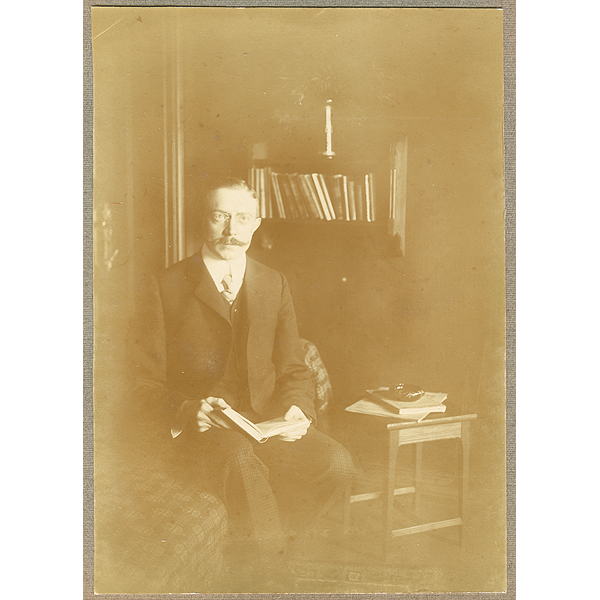
1910 – A gentleman holds a book in the living room of his home in Dillenburg, Germany. Scan © by Mark Zanzig/zanzig.com
The story behind the image
Here is another very old photo from our family archive. It shows a middle-aged gentleman sitting in the living room of his home in Dillenburg, Germany. I don’t know a lot of this branch of the family, but looking at the image series in the archive he apparently had been experimenting with both documentary photography as well as staged images.
To me, it seems possible that he had considered opening a photo studio and now learned the technology, how to set the lights and develop the negatives and prints. What’s more, this could be an early ‘selfie’ shot, i.e. he prepared the camera and then used a mechanical remote shutter release, or a self-timer to capture himself on film.
It is interesting to know that self-timers and remote shutter releases for cameras already existed as early as 1910. The Autex by Ernemann, in particular, was a well-known clockwork self-timer that operated a cable release. It even had a fold-out signal disc for remote monitoring of the shutter release enabling you to see when the picture was taken.
Just for fun, I asked ChatGPT to create a story out of this scenario, told from the photographers point of view:
“It is December 12th, 1910. Snow has softly covered the market square this morning, and the wood crackles in the stove. I’ve set up the camera – for the first time all by myself. A glass plate negative is ready, the shutter is cocked. I’ve put on my best jacket, my tie tightened. I want people to see me as I am: a man who works, reads, reflects.
Perhaps I’ll send the picture to my sister, perhaps I’ll just keep it in a drawer. But I like being able to determine the moment myself. Not like in the studio, where the photographer impatiently measures time and puts me in front of a generic backdrop. Here I can linger, the book in my hands, as if I were sitting in conversation with an old friend or member of the family.
The light is dim, the winter day short – but the light is good enough. I’ll develop the plate later today. And then, captured on glass, there will be this moment: my face, my place, my life – just as I see it today.”
Source: ChatGPT
Let’s get back to reality. You may think that this image looks bad, and you are right. It is not up to standards even considering the technology back in 1910 (which was already pretty advanced in terms of photography.) But truth is: the print is in a very bad condition today, see below. It has faded significantly, and we also have to admit that the setup was not an easy one. A rather dark living room, a dark suit, a bright white shirt and a brightly illuminated face. The light source was probably just the available light that streamed from the window.
Anyway, in my edit I tried to create the look the photographer probably had in mind.
You can find further images from this series here, here, here, and here.
Design ideas

The high resolution image
| Capture Date | c. 1910 |
| Image Source | 11.8 x 16.4 cm black & white print |
| Digital Image Source | EPSON Perfection 4870 Photo |
| Digital Image Source Format | TIFF, 48 bits/pixel, sRGB |
| Edited Image Format | JPEG, 24 bits/pixel, sRGB |
| Edited Image Dimensions | 5508 x 7876 Pixels |
| Copyright | Scan © by Mark Zanzig/zanzig.com |

 Zanzig.com Photo Hub
2 Comments