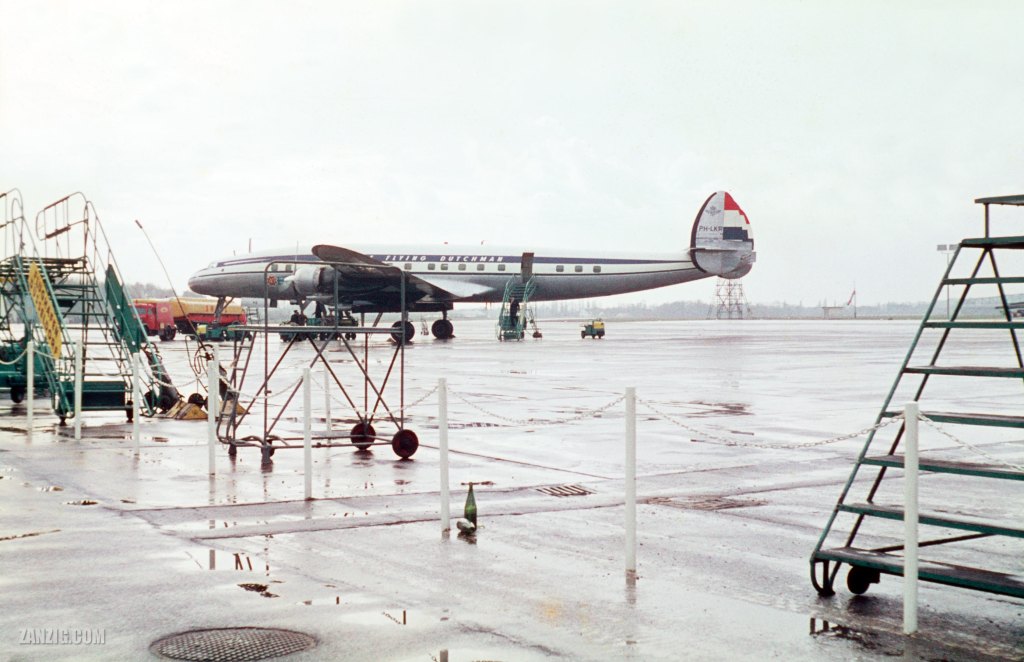
UNDATED – PH-LKR, a Lockheed L-1049C Super Constellation operated by KLM, at Düsseldorf (DUS) airport in Germany. Scan © Mark Zanzig/zanzig.com
The story behind the image
Here is another exciting image straight from the early 1960s.
This original 35 mm slide shows PH-LKR, a Lockheed L-1049C Super Constellation operated by KLM, at Düsseldorf (DUS) airport in Germany. According to this site, the plane was delivered to KLM in June 1953 and served the airline for exactly ten years (until June 1963).
I wondered why the airplane was scrapped after just ten years in service. I asked Google AI, and the answer makes a lot of sense:
The Super Constellation was technically a “diva” aircraft – beautiful to look at, but highly demanding to operate and often unreliable.
The retirement of PH-LKR and similar aircraft after only about 10 years had three main reasons:
The “best three-engine aircraft in the world”
The engines were technologically at the absolute limit of what was mechanically feasible for piston engines and were extremely prone to overheating and fires. Because of the frequent in-flight engine failures, the Super Constellation was often mockingly called the “best three-engine aircraft in the world.”
The complexity of the turbo-compound technology (which used exhaust gases to increase performance) required enormous and expensive maintenance.
The “Jet Shock”
The demise of the PH-LKR was primarily sealed by the technological leap of the early 1960s. Around that time jets like the Boeing 707 and the Douglas DC-8 entered the market. These were twice as fast, could carry more passengers, and, above all, were significantly more reliable and required less maintenance than the complex piston engines.
For airlines, it no longer made economic sense to operate the expensive aircraft type on long-haul routes when jets could fly the same distance in half the time.
Declining resale value
Since all major airlines switched to jets simultaneously, the market was flooded with used propeller aircraft. Many Super Constellations, like PH-LKR, were therefore not resold but scrapped directly, as their metal value was higher than their value as an outdated, maintenance-intensive airliner.
Of course, it is lovely to see the old plane with a crew member leaving through the aft exit, the old fuel transporter and the general simplicity of the airport. A fun detail at the bottom center is a leftover champagne bottle.
A nice image for airplane enthusiasts.
Disclaimer: Google AI contributed to this article.
The high resolution image
| Capture Date | early 1960s |
| Location | Düsseldorf, Germany |
| Camera | n/a |
| Image Source | 35mm color slide |
| Digital Image Source | EPSON Perfection 4870 Photo |
| Digital Image Source Format | TIFF, 48 bits/pixel, sRGB |
| Edited Image Format | JPEG, 24 bits/pixel, sRGB |
| Edited Image Dimensions | 6686 x 4325 Pixels |
| Copyright | Scan © by Mark Zanzig/zanzig.com |

 Zanzig.com Photo Hub