
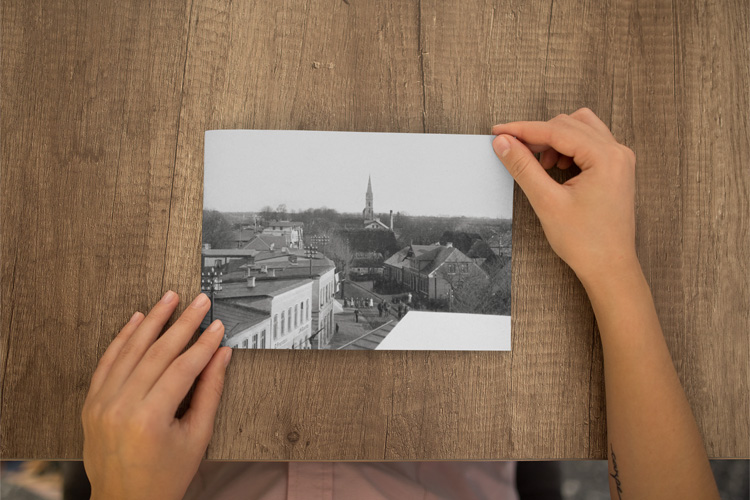
1902 – View across Süderbrarup in Germany. Scan © Mark Zanzig/zanzig.com
The story behind the image
Here is a scan of a postcard that is highly relevant for my family tree.
The card was sent in May 1902, i.e. roughly at a time when my great-grandmother, Alwine Scharck, gave birth to her son Arthur, who had been – as far as I know – her only child. Arthur was born and baptized in Süderbrarup, the town shown on the photo above.
Born in 1878 in Kiel, Alwine grew up in turbulent times. Shortly before, her father had moved from the countryside to the buzzing city of Kiel to work as a bricklayer. After a couple of years he realized that this was not his cup of tea and moved back to the area between Eckernförde and Flensburg, and so Alwine got confirmed in Schleswig in 1893.
Five years later, in 1898, she married Johann Joachim Christian Schultze, who was 12 years her senior. The marriage took place in Gravenstein which belonged (back then) to Germany. (Today it is Danish.) But the marriage did not last for long and the couple got divorced in or before 1904.
In November 1904, little Arthur was born in Süderbrarup where Alwine was working as a housekeeper. He was born as an illegitimate child, and the father remained unknown.
The following year, Alwine married again, a man called Hinrich Christian Jakob Schlüter. This marriage lasted longer than the first one, but it also got divorced (in January 1914.)
In February 1915 she married her third (and final) spouse, Peter Ferdinand Matthias Petersen, who became one of the keepers of the lighthouse in Bülk near Kiel. With Peter, Alwine apparently found the happiness she had been looking for. When he died in 1952, she moved to a small community near Gettorf called Wulfshagenerhütten where she died in 1962.
So, Alwine presumably spent at least a few years in Süderbrarup, which is why I was extremely happy to find this postcard. While it was in a good condition, it had the usual scratches and spots all over the image, but was generally in a good condition. BUT there was a terrible handwriting across the sky. To me, this was both a technical challenge – it’s not super easy to remove the handwriting from the sky – and an ethical challenge – is it okay to do such a heavy edit to an existing image? I realized that the original (unused) postcard was closer to my edit and so I decided to remove the handwriting.


Now the image is a joy to look at again! 🙂
Sadly, the neither the photographer nor the publisher are mentioned anywhere. But whoever it was, he captured an amazing picture, probably from a tall tripod that he put on highest roof he could find.
I have some difficulties to imagine how he actually prepared the shot, though. You see, there are nine people in the image (and two horses), and they all face the photographer. How did he get these people to participate in the shooting? Did he arrange them carefully in the middle of the street and then ran up the stairs to the roof? Did he shout instructions from the roof? Or did he have an assistant doing the arrangement? Also, there certainly was little traffic these days but it still must have been challenging to stop it nonetheless.
The print itself is pretty good and reveals tiniest details, for example the signage for Carl Stüwe, a local portrait photographer. (It is on the wall next to the sign for J.H. Geertz, a local hairdresser and barber.)
A real gem that now goes to the family archive.
Design ideas

The high resolution image
| Capture Date | 1902 |
| Photographer | unknown |
| Location | Süderbrarup, Germany |
| Image Source | c. 9.2 x 14.1 cm photo postcard |
| Digital Image Source | EPSON Perfection 4870 Photo |
| Digital Image Source Format | TIFF, 48 bits/pixel, sRGB |
| Edited Image Format | JPEG, 24 bits/pixel, sRGB |
| Edited Image Dimensions | 6687 x 4345 Pixels |
| Copyright | © Mark Zanzig/zanzig.com |

 Zanzig.com Photo Hub