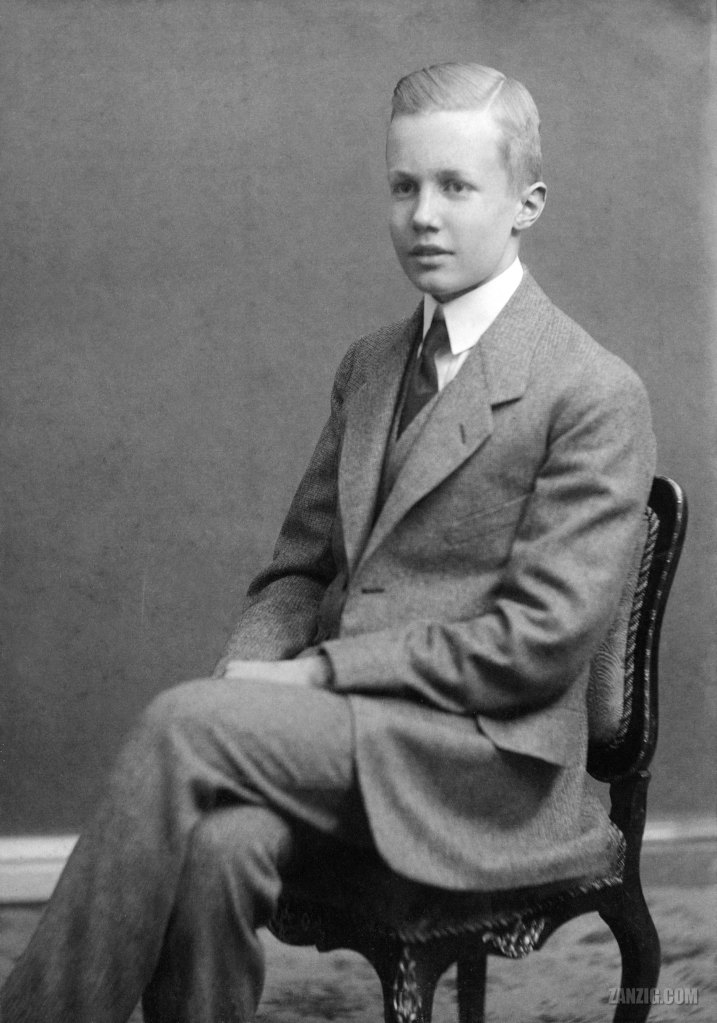
UNDATED – A portrait of Kurt Pahlke in Germany. Photo: Otto Stiegler, Itzehoe
The story behind the image
This historic cabinet photo shows Kurt Pahlke in a photo studio in Itzehoe, Germany. The back just carries the studio adress and the handwritten name of the young man.
Now, who was Kurt Pahlke?
He was born in 1899 in Hadersleben, a Danish village that (back then) belonged to Germany. He was the first son of Reinhard Pahlke and his wife, Elaine Irma Schött who had married in the town of Rheydt in North-Rhine Westphalia in 1898. After the wedding, Irma moved in with Reinhard who had already been living in Hadersleben for a while, working as a government official.
In 1904 the family moved to Itzehoe where Reinhard would become chief of the county Steinburg for many years to come. In 1923, he was appointed Landeshauptmann and moved from Itzehoe to Kiel. In 1932, he retired and moved to Wiesbaden in the south of Germany.
But let’s get back to Kurt. He had two borthers: Emil Reinhard, born 1901 in Schleswig, and Georg, born in 1904, but I have to find out where, exactly. (Itzehoe would be my guess.)
As a Landeshauptmann, his father Reinhardt was in touch with the leaders of the country and other high ranking persons. And so he wrote a letter to his son Kurt in 1927 that exactly described a meeting with President Hindenburg in Kiel, who even lived at the time at the Pahlke family. (The letter has been archived.)
In 1948, the financial ministry of Schleswig-Holstein wrote an employment reference for Kurt who had been working in the British Property Control Office for the Flensburg region, heading the office in Flensburg. So, apparently, he had also pursued a government career.
After 1948, the trace of Kurt gets lost.
The photo shows Kurt as a youngish man, probably at the age of 20, in Itzehoe, so I think the image was taken around 1919. The suit is still too large (I think) but looks modern. The print also confirms the estimated production date. It is a large cabinet card made from solid cardboard, a format that was quickly getting out of fashion after WW1 as it was being replaced by the more versatile postcard prints.
A truly inspiring family history.
P.S.: I do not claim that the above writeup is the ultimate truth. Of course, it could be that there is a different Kurt Pahlke. However, the names and locations seem to match very well, so I think that the story above is close to reality.
* * *
The photographer
Otto Albert Stiegler was born on the 27th June 1869 in Buenos Aires, Argentina, as a son of Philipp Quirin Stiegler and Helene Hinsch. At some point in time he moved to Hamburg, Germany. I cannot say whether he became a photographer in Argentinia or Germany but when he married Frieda Berger in 1892 in Hamburg, he already had the job title ‘photographer’. They moved on to become long-time residents of Itzehoe, where Otto operated his photo studio from about 1898 to the early 1920s. He began in Poststraße and around 1905/06 relocated to Feldschmiede 17-21 where he also shot the image above. Apparently, he closed the studio after 1920 but continued working as a photographer. In 1936 he still showed up as photographer in the Itzehoe address book in Feldschmiede 103 along with his wife.
Otto Stiegler died on the 8th April 1938 in his home at the age of almost 69 years.
His wife Frieda survived him by 15 years and died in Itzehoe on the 11th October 1953, aged 83 years.
Design ideas
The high resolution image
| Capture Date | c. 1919 |
| Photographer | Otto Stiegler, Itzehoe |
| Location | Itzehoe, Germany |
| Image Source | Albumen print, c. 10 x 14.4 cm, mounted, cabinet format |
| Digital Image Source | EPSON Perfection 4870 Photo |
| Digital Image Source Format | TIFF, 48 bits/pixel, sRGB |
| Edited Image Format | JPEG, 24 bits/pixel, sRGB |
| Edited Image Dimensions | 9519 x 13591 Pixels |
| Copyright | Photo © Otto Stiegler, Itzehoe Scan © Mark Zanzig/zanzig.com |

 Zanzig.com Photo Hub