
1950s – The Bräutigamseiche (‘Bridegroom’s Oak’) at the Dodauer Forst near Eutin in Germany. Photo © Cramers Kunstanstalt Dortmund (CeKaDe)
The story behind the image
Today is our wedding anniversary, and so I picked this glass negative from my collection to explain the superb quality of these films. Infact they have been mounted to solid glass and are typically much larger than 24×36 mm films. As the name suggests, glass negatives are negatives, i.e. they show the image using inverted gray tones.
This glass negative I acquired some time ago shows the Bräutigamseiche (‘Bridegroom’s Oak’) at the Dodauer Forst near Eutin in Germany.
It has a story of its own because it is the world’s only oak tree with its own postal address!
It all began like a fairytale. On June 2, 1891, the daughter of Chief Forester Ohrt and the Leipzig chocolate manufacturer Schütte-Felsche were married under this oak tree. Initially, the young girl’s father disapproved of the relationship with the chocolate manufacturer. However, the couple secretly kept exchanging messages and declarations of love, using the knothole in this gnarled, ancient oak tree for this purpose. When the forester finally gave up his resistance, the young couple exchanged vows under this tree.
Visitors to the area heard of this ‘happy romance’ and spread the story of the oak tree which soon was called the “Bridegroom’s Oak.”
And since 1927, the oak tree even has had its own postal address:
Bräutigamseiche
Dodauer Forst
23701 Eutin
Germany
To this day, letters from around the world get delivered into the hole in the tree almost every day. Love-seekers from the area pull them out and read them. The content can be anything, really, from genuine love letters to advertising. It is said that more than 100 marriages have been supported by the oak tree. (I have no idea how this number might have been calculated, though.) Read more at Wikipedia, in German.
Uh, where was I? Ah. Glass negatives! I scanned this negative at 4,800 dpi which is probably a too high resolution (2,400 dpi seems more appropriate) but I wanted to squeeze out the last bit of information from the original. Yet, scanned in RGB colors (48 bits/pixel) this would have been a file of 3 GB which is too large. Using 16 bit greyscale TIFF reduced the size to around 1 GB, a size that can be handled well in Adobe Photoshop. Still, it’s not for the faint hearted to work on a 500 Megapixel image. Just imagine: a 24×36 mm negative covers about 6.5% of the area of this glass negative.
The image quality has just blown me away. Very nice shades throughout the image and already in the original scan without any editing. And once the size is reduced, it looks even better, because the grain becomes less visible.
Glass negatives? Get one if you have the chance!
P.S.: No, Petra and I did not meet through the services of the oak! 🙂
Design ideas
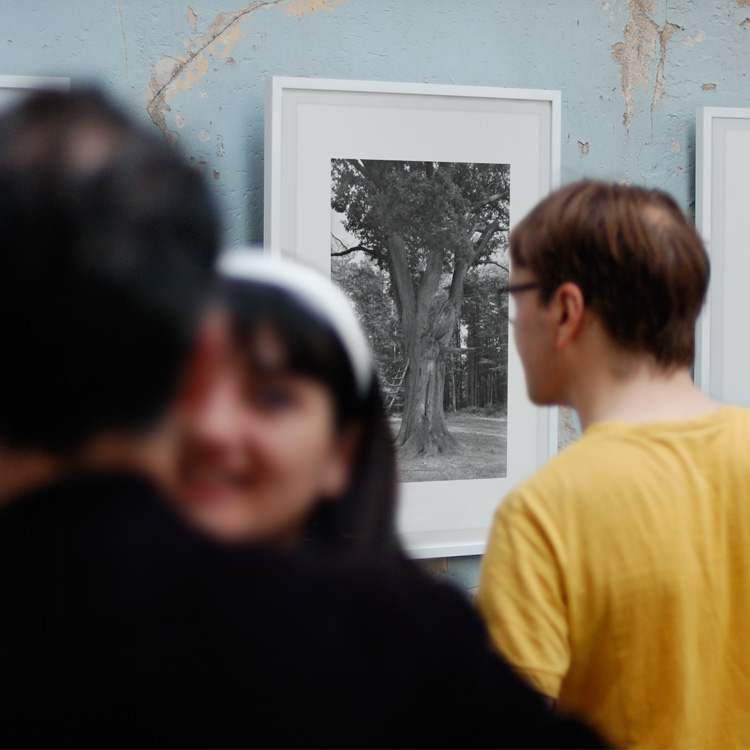


The high resolution image
| Capture Date | 1950s |
| Location | near Eutin, Germany |
| Image Source | 15 x 10 cm glass negative |
| Digital Image Source | EPSON Perfection 4870 Photo |
| Digital Image Source Format | TIFF, 16 bits/pixel, greyscale |
| Edited Image Format | JPEG, 8 bits/pixel, sRGB |
| Edited Image Dimensions | 18306 x 27320 Pixels |
| Copyright | Photo © Cramers Kunstanstalt Dortmund (CeKaDe), Scan by Mark Zanzig/zanzig.com |

 Zanzig.com Photo Hub