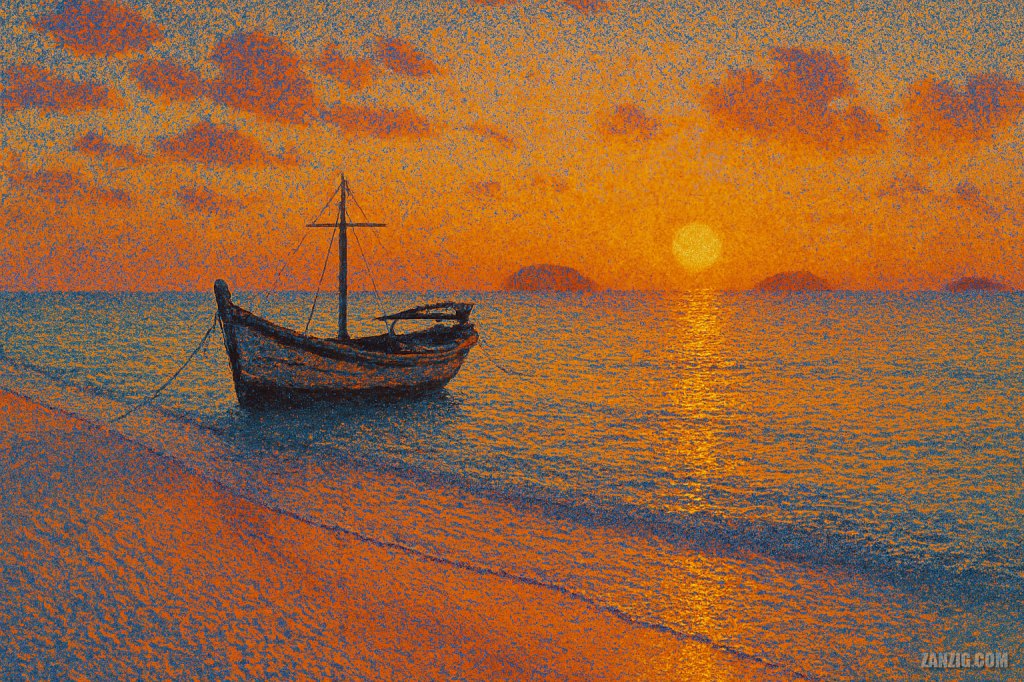
APRIL 2025 – AI generated image showing a sunset at a beach with an old boat, pointilism style. © Mark Zanzig/zanzig.com/Photo: ChatGPT
Generative AI in Art
Last week I wanted to see what generative AI can actually do in photography, and I had a lot of fun with it. I created images of an action figure showing myself, a beautiful sunset at the beach, and an exciting sunset over the harbour of Kos in Greece.
Now I wanted to take this excercise one step further. What about creating art? A former colleague of mine collects paintings created using the technique called pointilism. It uses tiny, distinct dots of pure color to create the image. When viewed from a distance, the individual dots blend together to form a complete picture. This technique was developed by Georges Seurat and Paul Signac in the late 1880s.
Now, I instructed ChatGPT to create a painting out of the beautiful sunset image that it had already created for me. Here’s the prompt:
Create an image from the uploaded file that looks like a painting by Georges Seurat using a technique called “pointilism” and keep the aspect ratio of 4 (width) to 3 (height).
(Please feel free to try the prompt with other artist names.)

I am not shocked any longer that the result is looking quite good. Okay, it has a 10 out of 10 rating on the Kitsch-o-Meter, but that’s not the point. The point is: The machine not only a created a nice photo out of nothing (well, nothing but my prompt). It also created a stunning piece of art out of nothing (i.e., just another prompt.) So, one could say that it created the entire piece out of nothing. Isn’t that what art is all about?
I’m just teasing here. I know that there is a hot debate going on whether generative AI works qualify as art, or whether it simply generates a regurgitated mass of (boring) pixels?
What if a smart programmer lets an application pick random words from the dictionary and ask the machine to create a nice artwork from it, e.g. with a generic prompt:
Create an image of [insert random subject] at [insert random location]. There should be a [insert random object 1] and a [insert random object 2] visible in the image. In the background, show [insert random detail of the location]. Make that image look like a painting by [insert random artist] using a technique called [insert randon painting technique] and keep the aspect ratio of 4 (width) to 3 (height).
What if this happens automatically without any human intervention, just based on popular searches of the last couple of hours, days, months? It would be interesting to see the results. Most certainly, some of the results would qualify as “art”.
Why not display the resulting images to random users who can like or dislike the images? Then display the top 10 of liked artworks the next day.
Oh my.
Design ideas


The high resolution image
| Creation Date | 14-APR-2025 |
| Creator | Mark Zanzig, based on an AI generated image by ChatGPT |
| Location | Munich, Germany |
| Digital Image Source | ChatGPT |
| Digital Image Source Format | JPEG, 24 bits/pixel, sRGB |
| Edited Image Format | JPEG, 24 bits/pixel, sRGB |
| Edited Image Dimensions | 1536 x 1024 Pixels |
| Copyright | © Mark Zanzig/zanzig.com/Photo: ChatGPT |
 Zanzig.com Photo Hub
2 Comments