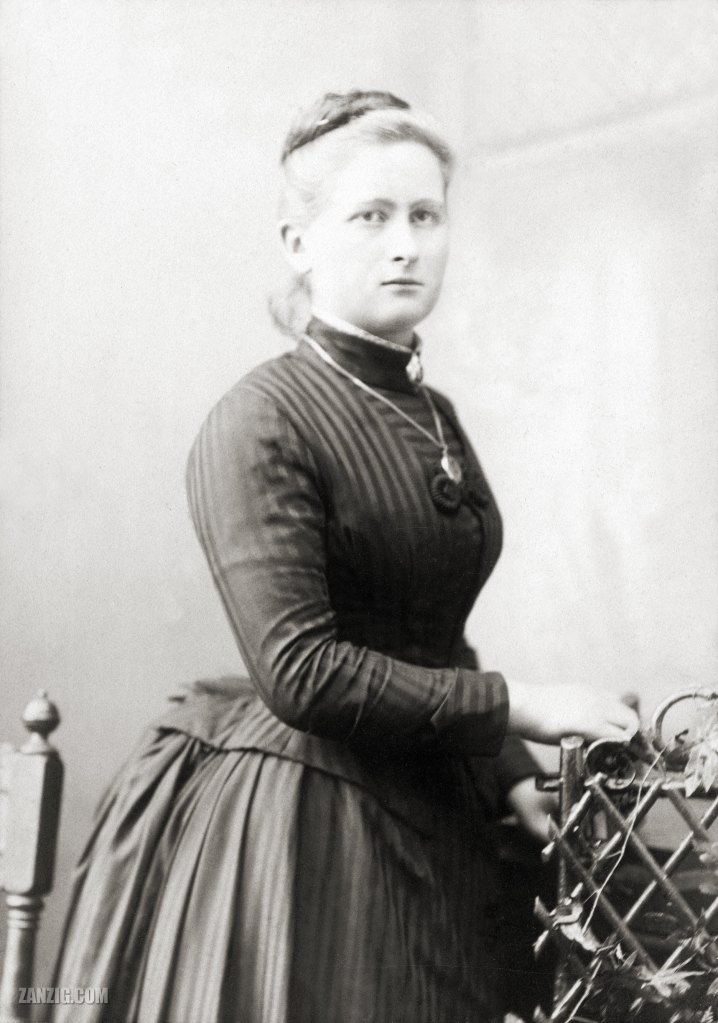
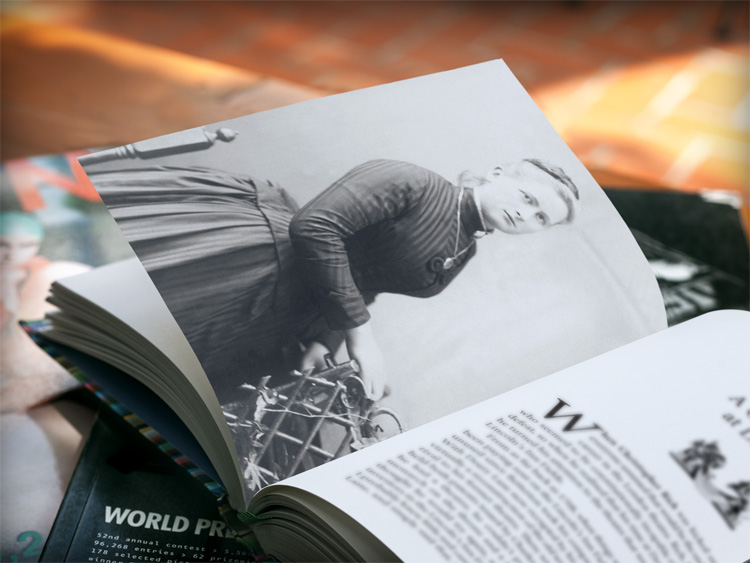
1890 – A cabinet photo shows Emilie Therese Hedwig Oßwald, born Schütze, at the age of 20 years in a photo studio in Weimar, Germany. Photo: Louis Held, Weimar
The story behind the image
Here’s an undated cabinet photo that was part of the Schütze-Oßwald lot I acquired recently. The studio portrait was shot by Louis Held in Weimar.
A handwritten note on the back just says: “[3] Hedwig Schütze 1890, 20 years.”
As her parents carry the numbers [6] and [7] we can assume that the numbers refer to the so-called Kekule notation and that the notes were applied by a child of Hedwig. This person would carry the number [1].
A quick search on Ancestry with this data – Hedwig Schütze, born 1870 +/- 2 years, in or around Weimar – returns her death record with a lot more information:
| First name | Emilie Therese Hedwig |
| Last name | Oßwald |
| Maiden name | Schütze |
| Date and place of birth | 18th April 1870 in Magdala near Weimar, Germany |
| Father | Gustav Heinrich Albin Schütze |
| Mother | Juliane Elisabeth Johanne Schütze, born Oehlwein |
| Husband | Karl Reinhold Gotthilf Oßwald |
| Date and place of marriage | 22nd September 1898 in Magdala |
| Date and place of death | 12th December 1947, Weimar, Germany |
And this information is fully aligned with the notes on the images of her parents. Wow.
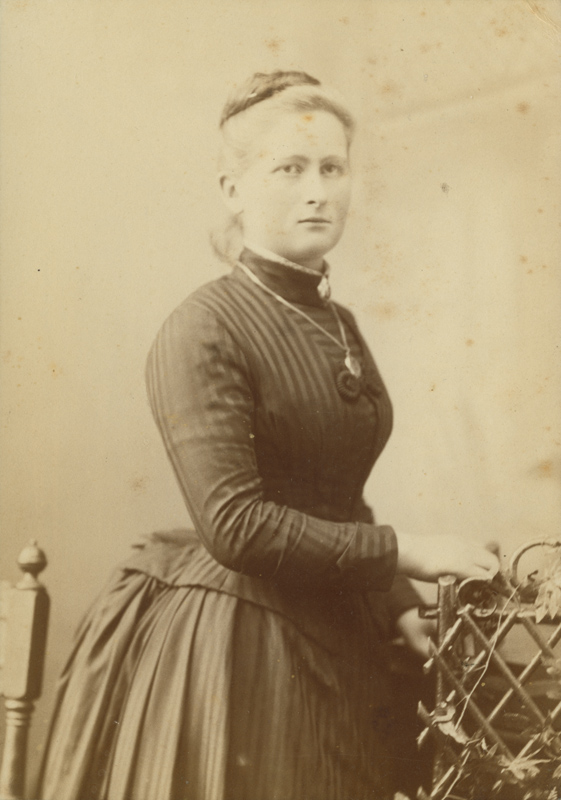
This large cabinet photo – an albumin print mounted on solid cardboard – is in a good condition, especially considering its age, but it shows some spots and minor damages here and there. It shows a bright yellow tint, and I think it’s a sign of age but it could well be that this was close to the original look when developed in the studio in 1890.
A drawback (to me) is that the image is not perfectly sharp. This puzzles me as cameras were typically mounted to a tripod back then, so typically at least the non-moving parts of the image are quite sharp. But they are not in this image. The only explanation I have is that the photographer – an expert of his time – focused on the face and used a large aperture, slightly blurring the fixed objects (the frame that Hedwig uses to keep steady, and the chair on the left). And then Hedwig did move ever so slightly during the long exposure of several seconds which slightly blurs her face and dress.
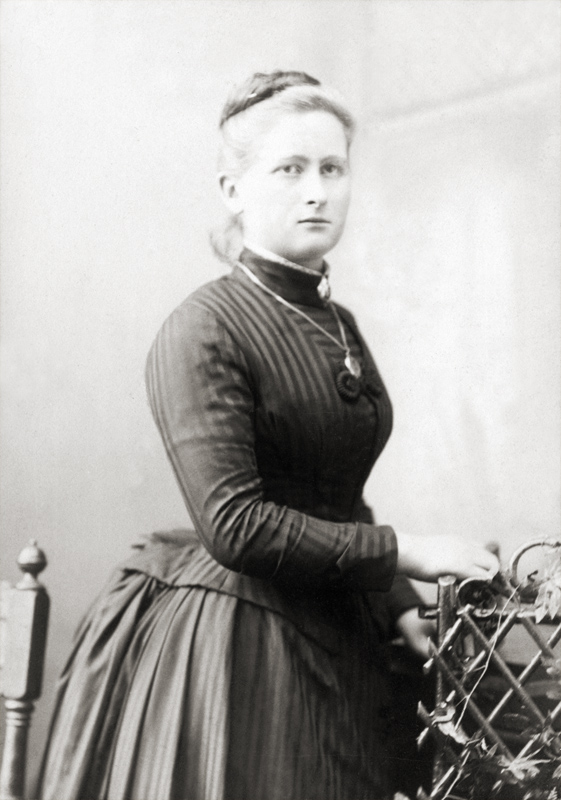
For enthusiasts of historic images, here’s a 1:1 comparison between the unedited, color-calibrated cabinet photo and its digitally re-mastered version.
* * *
The photographer
Louis Held (1851-1927) was a photo pioneer of his time. On April 1, 1882, he opened his photo studio in Weimar, always trying to expand his artwork into new areas that went beyond traditional portrait photography. For example, he photographed people and artists outside the studio in their surroundings, in their living and working environment. He also documented daily life in Weimar as one of the first press photographers in Germany. From 1910 he also explored the moving images and created several documentaries and news clips. In 1912, he founded a cinema in Weimar.
At the time of writing, the photo studio still exists at Marienstraße 1 in Weimar, owned and operated by photographer Stefan Renno who uses modern photo technology and maintains the extensive archive.
Read more about Louis Held at Wikipedia (in German.)
Design ideas

The high resolution image
| Capture Date | 1890 |
| Photographer | Louis Held, Weimar |
| Location | Weimar, Germany |
| Image Source | Albumen print from a glass negative, mounted to cardboard, cabinet format (c. 10 x 14 cm) |
| Digital Image Source | EPSON Perfection 4870 Photo |
| Digital Image Source Format | TIFF, 48 bits/pixel, sRGB |
| Edited Image Format | JPEG, 24 bits/pixel, sRGB |
| Edited Image Dimensions | 9455 x 13482 Pixels |
| Copyright | Photo © Louis Held Scan © Mark Zanzig/zanzig.com |
 Zanzig.com Photo Hub
4 Comments