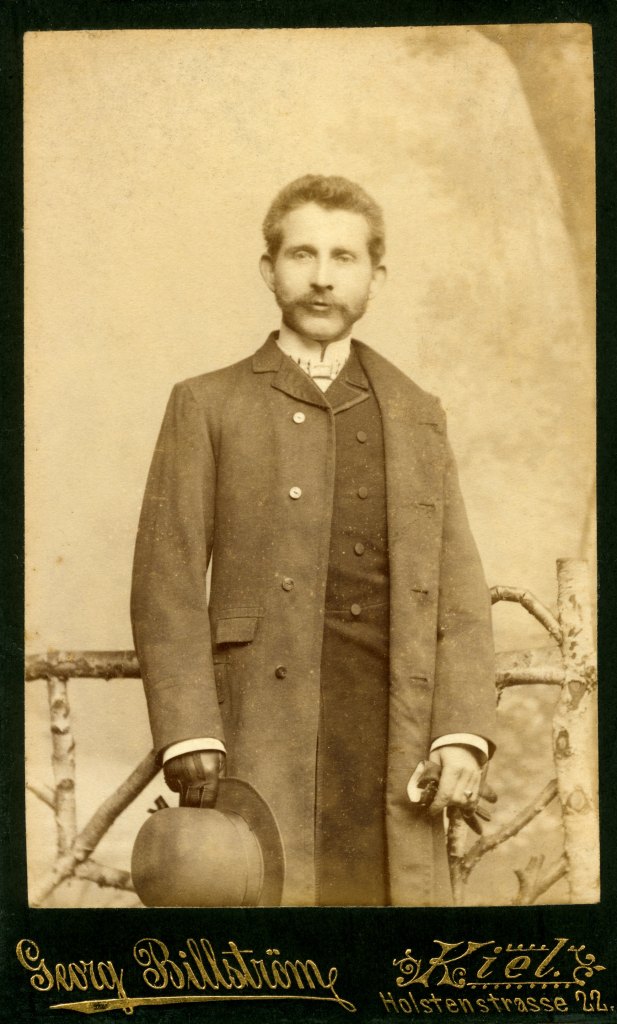
Undated portrait of a man, photographed by Georg Billström in Kiel in Germany. © by Mark Zanzig/zanzig.com
The story behind the image
This historic photo was shot by Georg Billström in his studio in Kiel, Germany, around 1890. It shows a man in his late 20s or early 30s, from his knees upwards. While this looks a bit awkward today, it was a popular angle at the time.
Photographer Georg Axel Michael Billström has a very interesting CV. He was born in February 1860 in Stockholm, Sweden, as son of Carl Axel Wilhelm Billström, a painter, and his wife Amanda Teresia Kosslow. I don’t know when and why Georg moved to Hamburg in Germany, but he worked as a photographer here. He also married Magdalena Friederika Carolina Pölckow here, in June 1886. Georg lived in Lange Reihe 50 (second floor) but moved to his wife’s appartment in Schauenburgerstraße 9 which is closer to the city center.
In June 1887 their son Rudolph Carl Axel was born, and in the following year the couple moved to Kiel which was a booming city back then. Sadly, Rudolph died in Kiel in 1888. Despite this sad event, Billström opened his studio in the city center at Holstenstrasse 22 where he stayed for about eight years (until 1897.) He became a popular, busy and creative photographer.
Then he moved the studio to Vorstadt 9 which was slightly off the historic old town (Vorstadt literally means ‘in front of the city’.) He called the studio Georg Billström – Atelier im Garten (Studio in the Garden). Back then, the houses still had large backyards and gardens.
Two images of my grandfather (here, and here) carry the address Vorstadt 9. The other two images (here, and here) were presumably shot by his successor, Karl Moeck.
The studio locations over time were:
- 1890-1897 Holstenstraße 22.
- 1897-1901 Vorstadt 9, Atelier im Garten.
- 1901-1941 Holstenstraße 43, Atelier im Garten – In 1901, the address for the studio in Vorstadt 9 changed because the street had been merged with the Holstenstraße, effectively extending the Holstenstraße beyond the Holstenbrücke, towards south-west.
In 1914, the studio was acquired by Karl Fürchtegott Moeck, a photographer from Hamburg (born 1884) who continued the studio under the Billström brand. The entry in the 1934 address book read:
Billström, Georg, Holstenstr. 43. Inh. Photograph Karl Fürchtegott Moeck
Moeck closed the studio in 1941, probably due to an air raid. He survived the war and died on in October 1962 in Kiel.
Family-wise, Georg and his wife were doing well. In Kiel they had at least another five children:
- Oskar Karl Gustav – born 10th November 1889, baptized 18th May 1891 in Kiel St. Nikolai.
- Irma Helene Amanda – born 15th April 1891, baptized 18th May 1891 in Kiel St. Nikolai.
- Walter Georg Harry – born 26th July 1892, baptized 25th December 1894 in Kiel St. Nikolai. Walter became a Grenadier in the First World War and got wounded in September 1914. He died in 1915 at the age of 22.
- Astrid Dora Maria – born 31st January 1894, baptized 25th December 1894 in Kiel St. Nikolai. Astrid married Karl Alfred Anton Weiß, a navy officer.
- Annita Elin Theodora – born 27th March 1900, baptized 19th October 1900 at home in Kiel.
In 1894 the family lived at Wall 1 which was just a few steps away from Holstenstraße 22. Later, the family moved to Von-der-Goltz-Allee 83 which did not belong to Kiel at that time. (Today it is part of the city of Kiel.) The commute to Holstenstraße would take just about 15 minutes by bicycle. Nice.
Funny fact: In 1912, Georg Billström opened a cinema at Brunswiker Straße 50. It was called Billström’s Lichtspiele and about 1,100+ seats, making it the largest cinema of the city. It closed in 1941 following a nightly air raid in the night of the 7th/8th April 1941.
His wife Magdalena died in June 1933 in Kiel at the age of 67 years. By that time Georg had retired for a while and moved to Brunswiker Straße 48, the house next to the cinema he founded in 1912. It was now owned and managed by his son-in-law, Arnold Frost.
On 15th April 1948, Georg Billström died at the age of 88 years in Kiel. In the church record, his profession was stated as “former cinema owner”. I would have expected “former photographer”, but this tells me that he was attached to the moving images and that his name was still well known across the city – for the cinema.
For all of his commercial photography life, and unlike most fellow photographers of his time – for example Ferdinand Urbahns, Julius Simonsen, and Albert Giesler –, Georg stayed just in the field of studio portrait photography. To my knowledge, he never published landscape photos, architecture photos, press photos, or postcards. He had become a true master at portrait photography, and his clients were looking exactly for this skill.
Now, you may wonder why I am telling you all this? Well, I believe that the photo above is a selfie of Georg Billström. On the back of the Carte de Visite is a price list. I’ve been looking at countless images shot by him. At the time of writing, none of these carried a price list. If this was a standard backside for years, it would have shown up somewhere. But no, there’s just this single image. And this makes this photo so interesting.
Why would Mr. Billström print a price list on the back of a photo? Most certainly to promote his new studio. After all, he was a creative person. The front would show the quality of his work – a perfect full body portrait (of himself?) – and the back would show the rates.
For paying customers he used different backs that were plain black or white, or with a nicely designed logo. Being always at the brink of trends, he changed the branding several times over the years.
Prices were quoted in Mark which was the offical currency back then. I found an official publication by Deutsche Bundesbank that calculated a conversion factor of 7.9 for the year 1890 (to convert Marks of 1890 to Euros of 2023.) This means that, for example, a set of 12 standard CdV photo prints (full body, or knee, just like above) would have cost 3 Mark x 7.9 = 23.70 Euros in 2023. It is not clear whether these would be 12 different images or just one image and 12 prints. This was his entry level offer. More sophisticated shots (kids, groups, upper body) were more complex and thus more expensive. Large cabinet photos were far more expensive than the CdV’s.
I admit that I was surprised by these prices. They do not sound extremely expensive to me. While certainly not discount offers, they sound affordable. Not something you’d purchase regularly, but who would do that anyway?
Now you know a lot about Georg Billström, one of the fascinating and innovative photographers of the past. His work will continue to live in the archives forever.
Design ideas
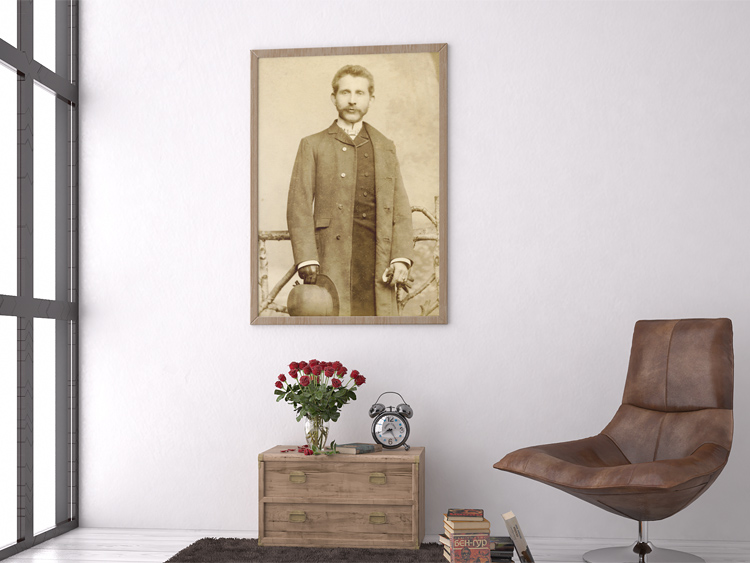


The high resolution image
| Capture Date | c. 1890 |
| Location | Kiel, Germany |
| Image Source | 9 x 14 cm black & white print |
| Digital Image Source | EPSON Perfection 4870 Photo |
| Digital Image Source Format | TIFF, 48 bits/pixel, sRGB |
| Edited Image Format | JPEG, 24 bits/pixel, sRGB |
| Edited Image Dimensions | 5864 x 9735 Pixels |
| Copyright | Scan © by Mark Zanzig/zanzig.com |
 Zanzig.com Photo Hub
9 Comments