
JANUARY 2024 – An Agfa Silette-L viewfinder camera with built-in Agfa Apotar 1:3,5/45 mm lens in a sturdy brown leather case. © Mark Zanzig/zanzig.com
A Camera From The 1950s
Here’s an old analog camera body I recently came across on eBay, and I gave it a try and purchased it. It’s a Silette-L from Agfa in Germany – back then a film and camera giant. It came with a sturdy brown leather case and a 36-page instruction booklet in German (Gebrauchsanweisung Agfa Silette-L) that explains the camera in detail.
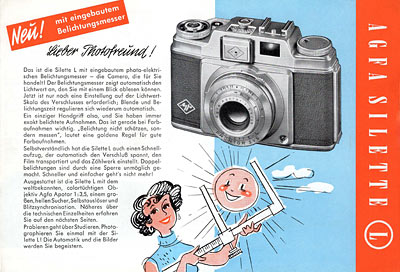
This model was launched in the summer of 1956 at a price of 189 DM excluding the leather case which cost another 22.50 DM. The price for the camera translated to roughly 800 Euro (870 US-Dollars) in January 2024. A heavy price tag that clearly positioned this model in the market for ambitioned amateurs.
When the body got delivered I was really excited.
You know, I grew up with analog cameras and I remember that my mother owned a similar camera that I was allowed to use as a teenager now and then. That camera was probably manufactured by Kodak, though. Anyway, I know my way around analog photography. At least, that’s what I thought.
Now I held the heavy camera – and I was puzzled. With the instruction booklet next to me, I wanted to follow the steps to capture a photo. But I realized that before I could take the camera for a test shooting I had to understand how the Agfa engineers had designed the workflow:
- Determine the exposure value (EV) for the scene.
The EV is a number that represents any combination of a camera’s shutter speed and f-number that results in the same exposure. It depends on the luminance of the scene and the sensitivity (speed) of the film used.
After all, it does not matter to the film whether you shoot an image, say, at 1/50 sec. at f/8 or at 1/100 sec. at f/5.6. In both cases the film will be exposed to the same amount of light, just at different combinations of exposure time and f-stop. Wikipedia has a good article with all the details on EV. - Manually transfer the metered EV to the lens.
This is necessary because there is no coupling between the exposure meter and the shutter. The built-in exposure meter just eliminates the need for a separate tool. - Pick a combination of f-stop and exposure time that works for you.
Based on the EV, the Agfa Silette-L couples f-stop and exposure time mechancially. This enables the photographer to conveniently shoot the same scene at different exposure time/f-stop combinations for any given EV without having to re-adjust the respective values separately every time. Just pick another combination, and you’re done.
Of course, the combination depends on your artistic goals. Do you need a rather narrow depth of field, e.g., for a portrait? Then use a wide open aperture, e.g. f/3.5. Or do you want to capture a landscape? Then use f/16. Need to freeze the motion? Use 1/300 sec. Or go for some extra motion blur? 1/20 sec. is your friend. You get the idea. (It gets tricky when you want to freeze a motion at 1/300 sec. with f/16 – you will need a really bright scene or a fast film. Or you aim for a motion blur with a shallow depth of field at 1/20 sec. and f/3.5. It better be dark! These combinations may not be possible within the limitations set by the luminance of the scene and the selected film speed.) - Set the focus manually.
- Take the image.
Once I understood the logic within the workflow it was not that difficult to capture a photo. However, I was still lacking the elegance and speed doing it. It took me a considerable amount of time to read the meter and adjust the EV at the lens. Picking a matching f-stop/time combination was rather easy, though.
But it is interesting that this concept is still being used today. The only difference is that our modern cameras (and smartphones) are packed with a lot of technology that assists us in finding the right combination of exposure time and f-stop, depending on an EV. We probably do not get to know the EV or that it is being used in the background.
What about my test shooting, then? Well, already during the first examination I found that this specific body seemed to have problems with the timing. While I did not measure them properly, it sounded to me that at least the longer exposure times were a bit too long. Also, the little flap covering the exposure meter was stuck, so the meter would only work in good lighting conditions. In the end I did not load a film but sold the body online as damaged/spare parts.
Yet, I got totally hooked by the experience and purchased another camera of the past that seems to work fine. This time I picked the successor, an Agfa Super Silette-L which features an improved exposure meter. The other day I inserted a first film to the body.
Of course, I will keep you posted on the results.

The high resolution image
| Capture Date & Time | 22-JAN-2024, 08:11 |
| Location | Unterhaching, Germany |
| Camera | Samsung Galaxy S5 neo (SM-G903F) |
| ISO | 200 |
| Exposure | 1/33 sec at f/1.9 |
| Digital Image Source Format | JPEG, 24 bits/pixel, sRGB |
| Edited Image Format | JPEG, 24 bits/pixel, sRGB |
| Edited Image Dimensions | 3101 x 2484 Pixels |
| Copyright | © by Mark Zanzig/zanzig.com |
 Zanzig.com Photo Hub
6 Comments