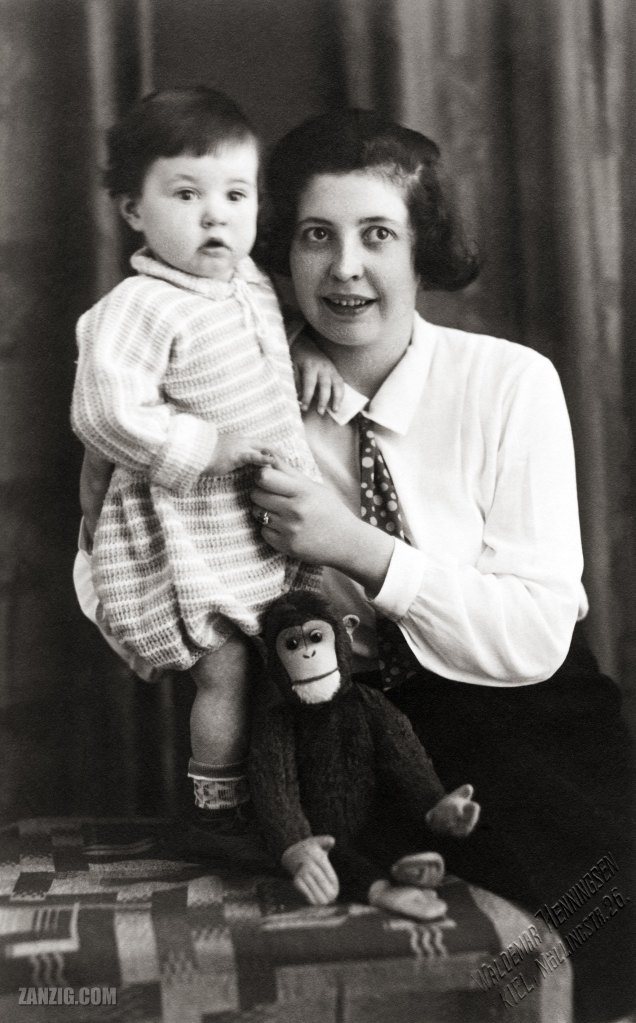
c. 1940 – A studio portrait shows Irmgard Marie Wilke (born Gehring) with her son Peter Wilke. Scan © Mark Zanzig/zanzig.com/Photo: Waldemar Hennigsen
The story behind the image
This is my great aunt, Irmgard Wilke (born Gehring), with her son Peter, photographed by Waldemar Hennigsen in his studio in Kiel. Irmgard was born in 1907 in Lensahn in Ostholstein. I never met her in person, sadly, and I am grateful to own this photo. The Wilke family lived in an appartment in Kiel at the Wilhelmplatz 2, just a few steps away from Henningsen’s studio.
Waldemar Henningsen had a tragic story, and its worth telling:
Born on February 25, 1890 in Kiel, Henningsen grew up as the youngest of eleven children with his parents. His father was a ship’s carpenter and died in 1926. His mother died in 1934. After his graduating from school, he completed a three-year photography apprenticeship. In 1912 he became a soldier and from 1914 to 1918 participated in the First World War. After the war he operated a photography shop. He remained single and lived together with his widowed sister, Louise Drepper.
On June 18, 1938, he was arrested for “fornication between men” and sentenced to six months in prison. The basis was Section 175 of the Criminal Code, which had been tightened in 1935. From June 18, 1938, he was in custody in the police prison in Kiel until August 8, after which he served his sentence in the court prison. Because of good behavior, his sentence was reduced by two months and he was released on October 19, 1938. On March 6, 1941, he was arrested again for “fornication between men” and this time sentenced to one year and three months in prison. Before the release scheduled for June 6, 1942, there was an exchange of letters between the criminal police department and the head of the court jail discussing whether Henningsen’s “precautionary police detention” “appears justified”. If so, it would have resulted in deportation to a concentration camp. The director certified Henningsen’s good conduct and therefore “only” recommended an inconspicuous observation by the criminal police. Nevertheless, the criminal police department extended Henningsen’s detention by two months and ordered subsequent “preventive detention” against him as allegedly “dangerous to the public”.
This resulted in deportation to the Sachsenhausen concentration camp, where Henningsen arrived on October 18, 1942. Homosexuals ranked low in the prison hierarchy and were marked with a “pink triangle” as a means of targeted discrimination.
Henningsen’s imprisonment in Sachsenhausen only lasted until November 19, 1942. On this day he died in the large brick factory which historians consider to have been an extermination camp for homosexuals. According to the official statement, the cause of death was “double-sided pneumonia”.
(Source: Stadt Kiel, German PDF)
Waldemar Henningsen’s story deeply saddens me. A photographer who – in our modern view of the world – did nothing wrong was killed just because some people disliked his sexual preferences? Gosh. We need to remember these victims of the past and prevent this from happening ever again.
I hope to contribute just a tiny piece to this remembrance with this post.
The high resolution image
| Capture Date | c. 1940 |
| Photographer | Waldemar Hennigsen, Kiel |
| Location | Kiel, Germany |
| Image Source | 8.9 x 13.8 cm print |
| Digital Image Source | EPSON Perfection 4870 Photo |
| Digital Image Source Format | TIFF, 48 bits/pixel, sRGB |
| Edited Image Format | JPEG, 24 bits/pixel, sRGB |
| Edited Image Dimensions | 3947 x 6349 Pixels |
| Copyright | © by Mark Zanzig/zanzig.com |
Zanzig.com shows images of the period from 1933 to 1945 only for the purposes of education, the defense against unconstitutional and anti-constitutional efforts, scientific, genealogic and art historical research, reporting on relevant current events, military history, and uniform research. By accessing this page you agree to use the images only for historical or scientific purposes for the reasons mentioned above and to not use them for propaganda purposes in any way, especially within the meaning of German § 86a StGB.
 Zanzig.com Photo Hub